
In villages across Pakistan, Bangladesh and Sri Lanka, 69.6% of adults with high blood pressure didn't have it under control when one large trial began. Most people in the trial were already taking medicine. High blood pressure control is hard in places where clinics are far away and nobody checks in. So researchers tested a simple idea: what happens if a health worker comes to your door?
Quick answer: regular home visits, as part of a wider package of care, helped control high blood pressure in rural South Asia. In the COBRA-BPS trial of 2,645 adults, the top number fell 9.0 points over two years with the program and 3.9 points with usual care. Blood pressure was under control in 53.2% of people at the end, compared with 43.7%. The visits came with trained doctors and clinic support, so they can't take all the credit.
This breakdown explains what counts as high blood pressure, what the trial did and found, what it cost, what it can't tell us, and what WHO advises.
What counts as high blood pressure?
A blood pressure reading has two numbers. The top number (systolic) is the pressure when the heart beats. The bottom number (diastolic) is the pressure between beats. WHO defines high blood pressure, also called hypertension, as 140/90 or higher, measured on two different days.
It is common and easy to miss. WHO estimates that 1.4 billion adults aged 30 to 79 had it in 2024. About 44% of them didn't know, and only 23% had it under control. Most people feel nothing, so measuring it is the only reliable way to find out.
The study: COBRA-BPS, 2,645 adults in 30 villages
COBRA-BPS was a randomised trial published in the New England Journal of Medicine in 2020. Whole villages, not individual people, were assigned by chance to the program or to usual care.
| Detail | What the study did |
|---|---|
| Who | 2,645 adults aged 40 or older with high blood pressure |
| Where | 30 rural communities, 10 per country: Thatta in Pakistan, Tangail and Munshiganj in Bangladesh, Puttalam in Sri Lanka |
| Comparison | Half the villages got the program. Half got usual care, where health workers visited homes only for mother and child care |
| How long | 24 months |
| Main measure | Change in the top number from the start to 24 months |
Source: Jafar et al., NEJM, 2020
What the home visits program included
The home visits were the centre of the program, but they weren't the whole of it. The paper describes five parts:
- Home blood pressure checks. Government community health workers measured blood pressure with a digital monitor every 3 months, and referred people with very high readings to a doctor.
- Health education at home. The same visits covered taking medicine and following up with a doctor, for the participant and their family.
- Trained doctors. Doctors at government clinics were trained in managing high blood pressure and followed a treatment guide.
- Clinic support. Clinics got a triage desk to cut waiting times, and a care coordinator to track people with very high readings.
- Payment for health workers. Workers were compensated for the extra services, at the discretion of the local health office.
Delivery was strong: 91.5% of participants received at least 80% of their planned visits, out of up to eight over two years. Patients in Pakistan and Bangladesh still paid for most of their own medicines and tests, in line with local norms.
What it found
| Result at 24 months | Program | Usual care | Difference |
|---|---|---|---|
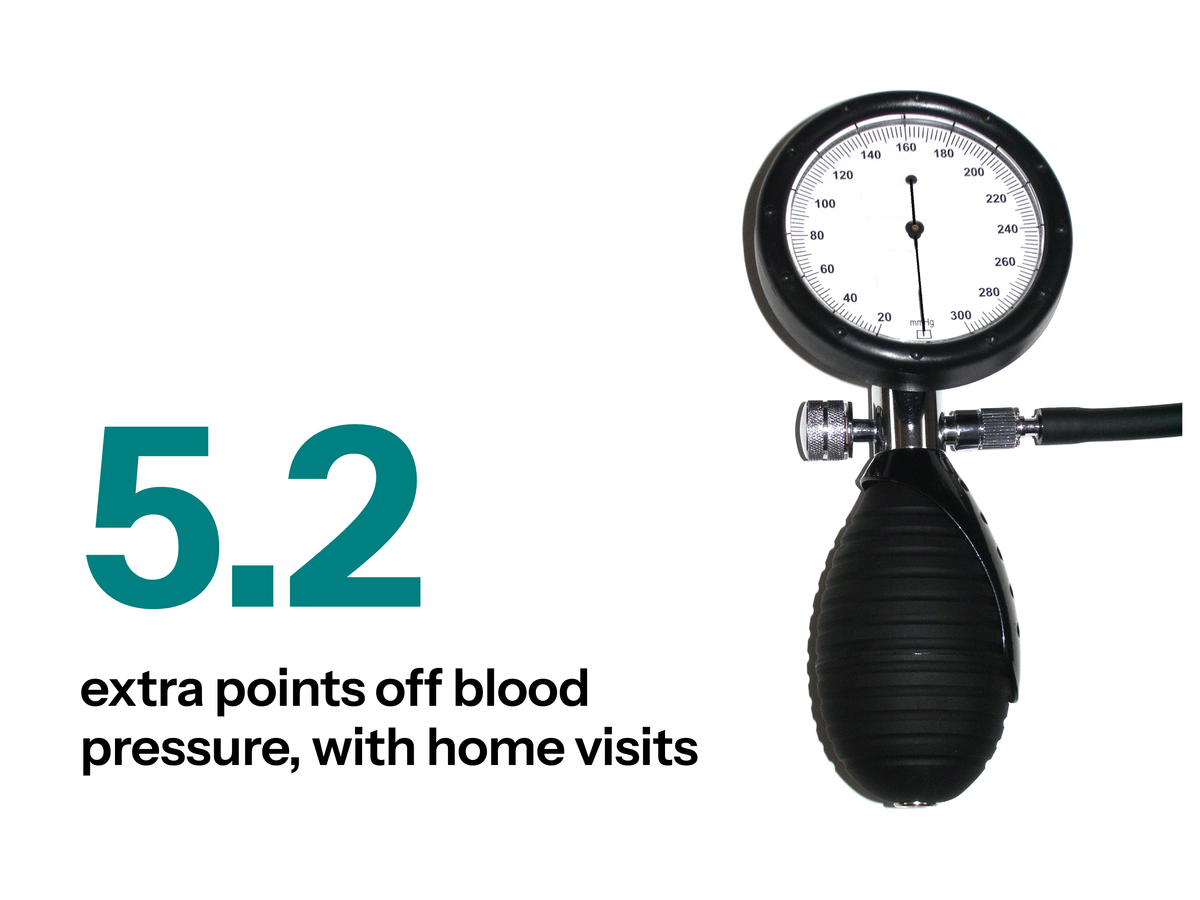
| Fall in the top number | 9.0 points | 3.9 points | 5.2 points more (95% CI 3.2 to 7.1) |
| Fall in the bottom number | Reported as a difference | 2.8 points more (95% CI 1.7 to 3.9) | |
| Blood pressure under control (below 140/90) | 53.2% | 43.7% | Relative risk 1.22 (95% CI 1.10 to 1.35) |
Source: Jafar et al., NEJM, 2020. The 5.2 differs slightly from subtracting 3.9 from 9.0 because of rounding.
The paper also reports deaths, and these need care. Deaths from heart and blood vessel disease were lower with the program: 8 people (0.6%) compared with 23 (1.7%). Deaths from all causes were 2.9% compared with 4.3%, which wasn't statistically significant. Causes of death weren't a planned outcome of the trial, and the authors say it was too short to properly assess heart events, so these numbers are a signal and not a finding to rely on.
What did it cost?
The researchers estimated the extra cost of delivering the program at scale at $10.50 per eligible patient in rural Pakistan, $10.70 in Bangladesh and $4.70 in Sri Lanka, and describe the annual cost as under $11 per patient. At about 277 rupees to the dollar in November 2026, Pakistan's figure comes to about Rs 3,000 per patient, per year. Treat that as a rough guide, because the costs were measured some years ago and the rupee has fallen since. It covers delivering the program, and patients in Pakistan still paid for most of their own medicines and tests.
What this means for high blood pressure in Pakistan
Pakistan's study area was Thatta in Sindh, and the paper reports that results were consistent in each country's own analysis. Two things stand out for hypertension in Pakistan.
First, having a prescription isn't the same as having blood pressure under control. Most people in this trial were on medicine at the start, and many of them were still above 140/90.
Second, the program ran through the government's existing health workers and clinics. It was built into the existing system, with added training and clinic support, which is why the authors see it as something that could be scaled up.
What the study can't tell us
- How much the visits did alone. The authors say the trial wasn't designed to separate the five parts. They suggest that better use of medicine may have played a substantial role, since trained doctors prescribed more medicines and higher doses.
- Whether it works in cities. All the sites were rural.
- Long-term effects. Two years is too short to show what happens to heart attacks and strokes.
- The full size of the effect. The authors note the benefit could be underestimated, because people in the usual care group may have changed their habits after researchers measured their blood pressure.
How to control high blood pressure: what WHO advises
This trial tested a health system program, so what you can do yourself comes from WHO's hypertension guidance:
- Get your blood pressure checked regularly, because it often has no symptoms.
- See your doctor, and take medicine the way it was prescribed. Your target may depend on your other health conditions.
- Eat more vegetables and fruit, and keep salt under 5 grams a day (2 grams of sodium). Avoid foods high in saturated or trans fats.
- Aim for at least 150 minutes of moderate activity a week, and sit less.
- Don't smoke or use tobacco.
When to get help now: WHO says very high readings, usually 180/120 or higher, can cause severe headaches, chest pain, difficulty breathing, confusion or an abnormal heart rhythm. If you have any of these symptoms and high blood pressure, seek care immediately. In Pakistan, call Rescue 1122.
The bottom line
In villages where many people on blood pressure medicine were still not controlled, regular visits from a government health worker, backed by trained doctors and better clinics, brought blood pressure down further than usual care. The trial can't say which part did the most. It does show that this kind of follow-up can work, at a low estimated cost, through health workers who are already there.
FAQs
Do home visits lower blood pressure?
In the COBRA-BPS trial, a program centred on home visits lowered the top number by 5.2 points more than usual care over two years. The visits came with trained doctors and clinic support, so the study can't say how much the visits did alone.
How can I control high blood pressure?
WHO advises checking it regularly, seeing your doctor and taking medicine as prescribed, keeping salt under 5 grams a day, eating more vegetables and fruit, staying active and not using tobacco. Your doctor can tell you what target is right for you.
Does high blood pressure have symptoms?
Usually not. WHO says most people feel nothing, so measuring it is the only reliable way to know. Very high readings can cause severe headaches, chest pain or difficulty breathing, and those need care immediately.
What blood pressure is considered high?
WHO defines high blood pressure as 140/90 or higher, measured on two different days. In this trial, under control meant below 140/90.
Did this study include Pakistan?
Yes. Thatta in Pakistan was one of the study areas, along with districts in Bangladesh and Sri Lanka. The paper reports that results were consistent in each country's own analysis. All the sites were rural, so it doesn't tell us about cities.
Sources
- Jafar TH, Gandhi M, de Silva HA, et al. A Community-Based Intervention for Managing Hypertension in Rural South Asia. New England Journal of Medicine, 2020;382:717-26. Read the study or the open access copy
- WHO. Hypertension fact sheet
- WHO. Sodium reduction fact sheet
- ExchangeRate-API. US dollar to Pakistani rupee, 9 November 2026
Disclaimer: Control Group is an initiative by Vitalis Living. This breakdown is for educational purposes only and does not constitute medical advice. If you have high blood pressure or another medical condition, speak to your doctor before changing your treatment.